

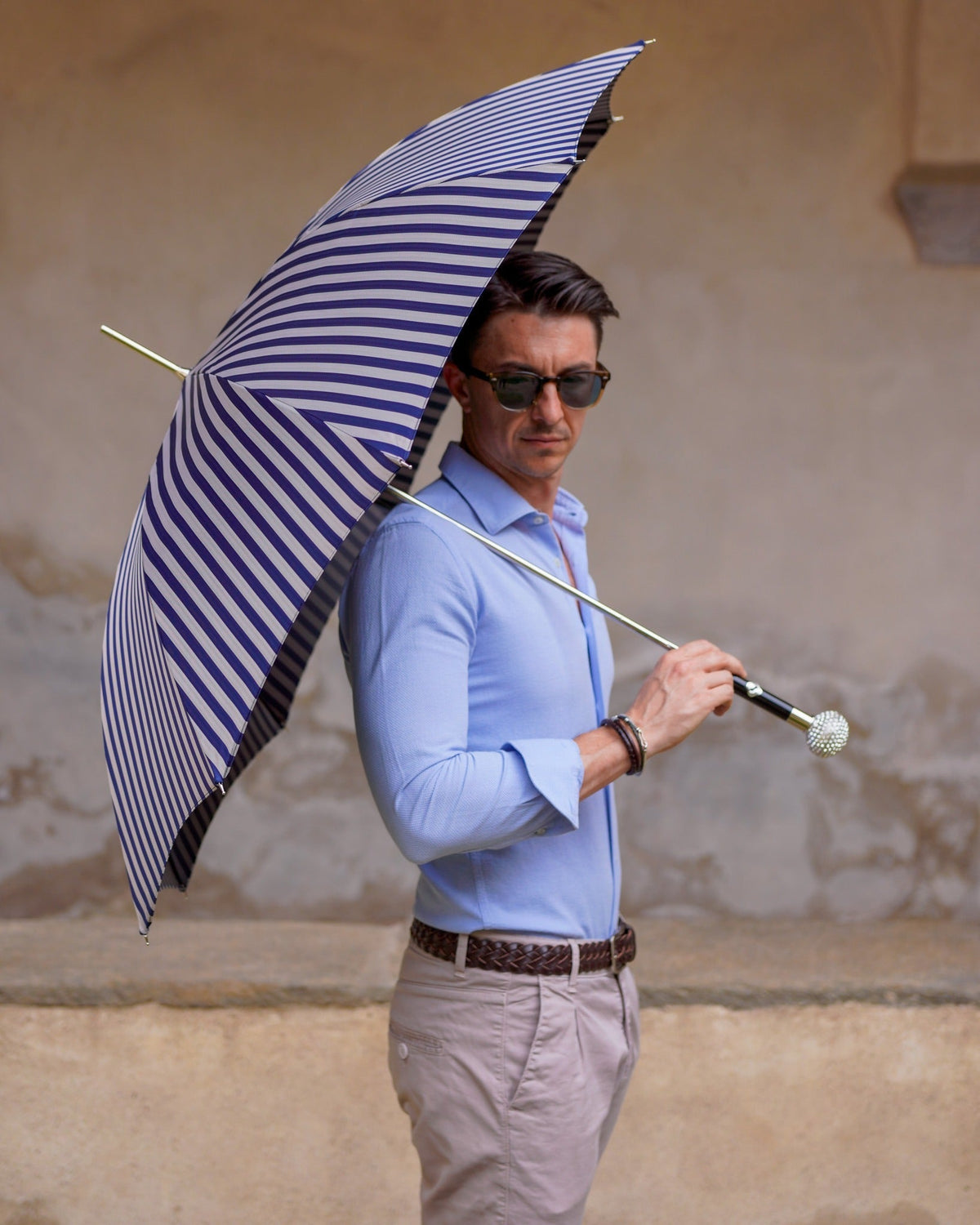
A workshop-floor breakdown of three objects the market treats as synonyms — and why that confusion is costing collectors money.
Ninety percent of the "parasols" listed for sale online are sunshades. We know this because we field the correction request weekly: a customer orders what a listing called a parasol, receives a folding beach canopy with an aluminum pole, and writes to ask where the hand-turned wood shaft went. The three terms — parasol, sunshade, luxury umbrella — describe three different manufacturing traditions, not three sizes of the same product.
Parasol, Sunshade, or Luxury Umbrella? The Three Words the Industry Uses Wrong
Why This Distinction Exists?
Each term carries its own construction lineage, and each lineage points to a different level of craftsmanship. Conflating them isn't just imprecise language — it's the reason buyers overpay for mass production or underpay for handwork without knowing it.
Fact / Metric / Insight:
Fact — "Parasol" derives from the Latin para (to shield) + sol (sun): a sun-specific tool by definition. Metric — "Umbrella" derives from umbra, Latin for shade, and only acquired its rain-specific meaning in 18th-century England. Insight — A product marketed as a "rain parasol" is, etymologically, a contradiction, and a signal the seller hasn't studied the category.

Parasol: The Original Sun Instrument
The parasol is the oldest of the three objects by several thousand years. Depictions of hand-carried sun shields appear on Persian royal reliefs and Assyrian carvings; ancient Greek pottery from roughly the 4th century BCE shows women shaded by parasol-bearers as a marker of status, not utility. The form migrated through Mesopotamia, India, and East Asia — where oil-paper parasols became both functional objects and fine art — long before it reached Europe.
Europe didn't adopt the parasol widely until the 17th century, and it took the Enlightenment salons of 18th-century France to make it a fashion fixture. By the Victorian era, parasol construction had become a craft in its own right: carved ivory and coral handles, hand-painted silk canopies, whalebone ribs. This is the era preserved in institutional collections — the Museo dell'Ombrello e del Parasole in Gignese, near Stresa, Italy, holds roughly 1,500 pieces including a parasol that belonged to Queen Margherita of Savoy. It remains one of the only museums in the world dedicated exclusively to this object category.
Defining trait: a parasol is engineered for sun exposure only. Its canopy fabric — traditionally silk, later cotton sateen — is not treated for water resistance, and its frame is not built to withstand wind-loaded rain use. Using one in a storm was, and still is, a material failure waiting to happen.
Sunshade: The Industrial Descendant
"Sunshade" is a 20th-century commercial term, not a historical craft category. It describes any UV-blocking canopy structure — beach shade, patio shade, stroller shade — built for function over form. There is no lineage of hand-turned shafts or artisan canopy-stitching behind the word. Sunshades are typically extruded aluminum or fiberglass, mass-cut synthetic canopy fabric, and sold by UPF rating rather than provenance.
This is the category confusion that costs buyers the most: a listing using "parasol" and "sunshade" interchangeably is very often selling the latter at the perceived value of the former.
Luxury Umbrella: The Rain-Engineered Object
The rain umbrella has a distinct — and more contested — origin story. Waterproofed, structurally reinforced umbrellas existed in China centuries earlier, but the object's adoption in the West is usually credited to Jonas Hanway, an Englishman who carried one publicly through 1750s London despite ridicule from sedan-chair operators who saw it as a threat to their trade. By 1830, the category had matured enough to support James Smith & Sons on New Oxford Street, London — the first shop built exclusively around umbrella retail and repair, and still trading today.
A luxury umbrella, as distinct from a mass-market rain umbrella, is defined by construction transparency: named wood species for the shaft, a stated rib count and rib material, a canopy panel count, and stitching method disclosed rather than hidden behind a brand name. This is the standard we hold every piece in the Artisan Umbrellas workshop to — including the Pasotti Ombrelli and Il Marchesato collections we carry, where each canopy is hand-cut from pongee or waxed cotton and hand-stitched to a beechwood or chestnut shaft, rather than heat-pressed to a fiberglass pole.
Parasol vs. Sunshade vs. Luxury Umbrella: Side-by-Side
| Attribute | Parasol | Sunshade | Luxury Umbrella |
|---|---|---|---|
| Etymology | Latin: shield + sun | Modern English, functional compound | Latin: shade (umbra) |
| Primary defense | UV / sun only | UV / sun only | Rain, wind, and sun |
| Origin era | Antiquity (Persia, Greece, China) | 20th century, industrial | 18th-century Europe (adoption); earlier in China |
| Canopy material | Silk, cotton sateen (non-waterproofed) | Synthetic, UPF-rated | Pongee, waxed cotton, technical rain fabric |
| Frame / shaft | Carved wood, whalebone (historic); aluminum (modern) | Extruded aluminum, fiberglass | Named hardwood (beech, chestnut), steel or fiberglass ribs |
| Construction disclosure | Rare outside museum pieces | Minimal (UPF rating only) | Full: rib count, panel count, stitch method |
| Collectible status | Yes — museum-held examples exist | No | Yes — numbered or limited editions |
Why the Terminology Is a Buying Filter
Once the three definitions are fixed, they become a diagnostic tool:
- If a listing calls something a "parasol" but rates it for rain — the seller is using the word loosely, and the construction claims deserve scrutiny.
- If a listing calls something a "sunshade" but prices it like a heritage piece — you're paying for branding, not material.
- If a listing calls something a "luxury umbrella" but won't name the wood species or rib count — there's likely nothing distinctive underneath the label.
This is the standard we apply to our own catalog: every Artisan Umbrellas listing states shaft wood, canopy material, and construction method in the same paragraph as the price — because a term without a disclosed material behind it is marketing, not a specification.
The Historical Case for Getting This Right
Museums don't catalog parasols, sunshades, and rain umbrellas under one heading, and neither should retailers. The V&A and the Gignese museum both hold parasols and rain umbrellas as separate typologies, cataloged by construction method and era, because the objects served different purposes and were built by different trades. Treating them as interchangeable erases the craft history each term protects — and makes it harder for a buyer to know what they're actually purchasing.
FAQ
Is a parasol the same as an umbrella?
No. A parasol is built for sun protection only, using non-waterproofed canopy fabric. An umbrella — rain umbrella or luxury umbrella — is engineered with waterproofed fabric and a frame rated for wind-loaded rain use. Using a parasol in rain will damage the canopy and frame.
What makes an umbrella "luxury" rather than just expensive?
Disclosed construction: a named wood species for the shaft, a stated rib count and material, canopy panel count, and hand-stitching versus machine-pressing. Price alone doesn't indicate craftsmanship — the specification does.
Are sunshades ever collectible?
Rarely. Sunshades are mass-produced functional objects rated by UV protection factor (UPF), not by material provenance, which is why they don't appear in museum textile or design collections the way parasols and rain umbrellas do.
Why do so many retailers use these terms interchangeably?
Search demand for "parasol" and "sunshade" is often bundled by marketplace algorithms, which incentivizes sellers to use whichever term ranks higher regardless of accuracy. It does not reflect any change in the underlying product definitions.
Teilen:
How to Store and Transport a High-End Umbrella Without Shortening Its Life?
Umbrella Etiquette Across Cultures: What the Well-Dressed Know