

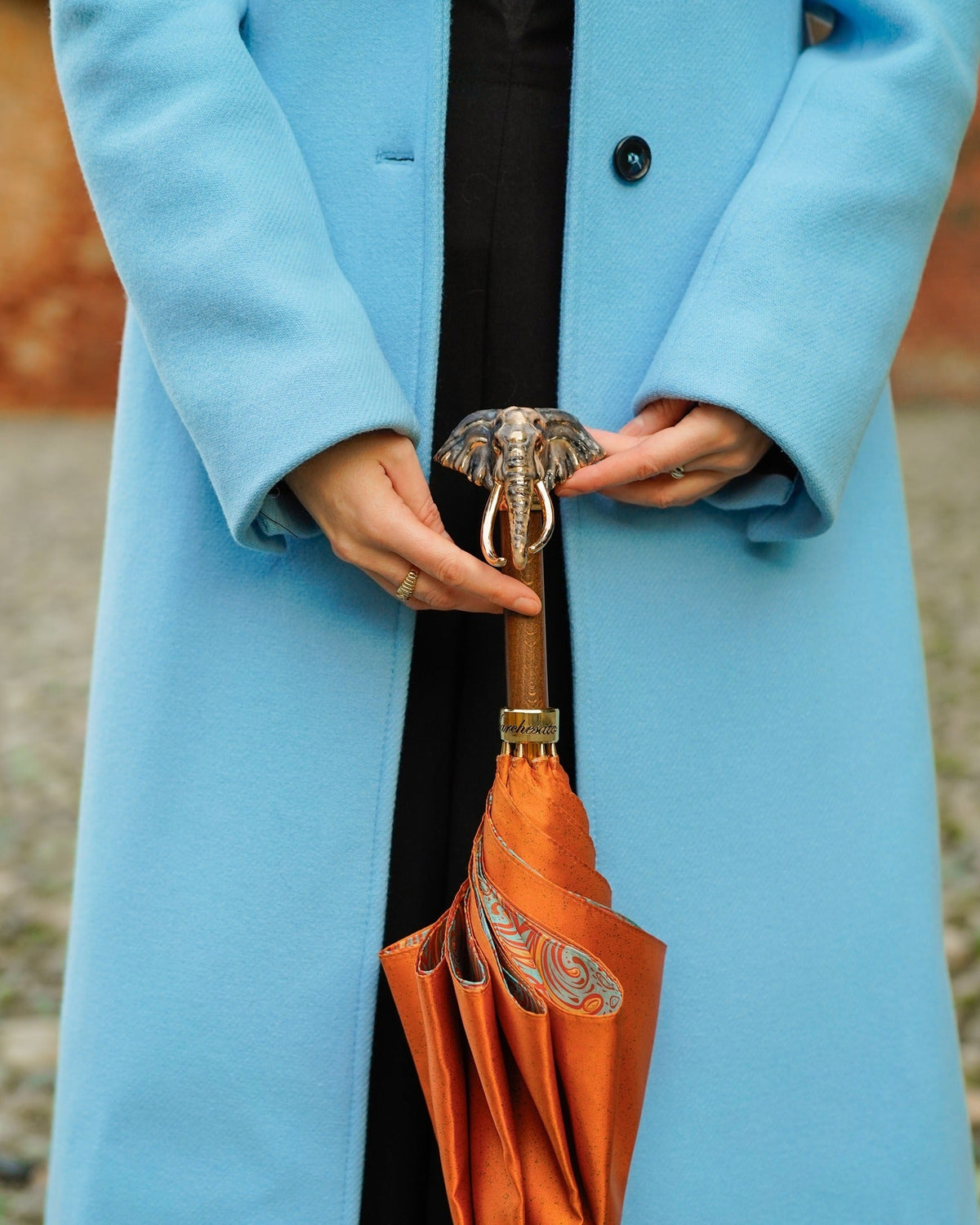
Most people choose an umbrella by canopy color and fold size. That's a mistake we watch clients make weekly — and it's the reason so many "luxury" umbrellas end up in a drawer after one season. The handle is the only part of the umbrella your hand actually remembers. Everything else is fabric and steel doing a job. The handle is the object.
At Artisan Umbrellas, every handle that reaches a client has already passed through a dozen hands in our workshop — sanded, oiled, checked under raking light for grain flaws, gripped for the "cold test" (does it warm to hand temperature in under 40 seconds, or does it stay clammy like cheap resin?). That process is what this article is actually about. Not umbrellas in general. Handles, specifically, and why the material under your palm is the single highest-leverage decision in the entire purchase.
Why Luxury Umbrella Handles Deserve More Attention Than You're Giving Them?
The Handle Is a Load-Bearing Decision, Not a Cosmetic One
A canopy gets replaced. Ribs get replaced. A handle, if chosen correctly, outlives both — and often outlives the umbrella it started on, since a well-made handle can be re-mounted onto a new frame. This is standard practice in Italian umbrella-making and one reason chestnut burl, briar root, and natural horn handles are treated as heirloom components rather than accessories.
Three properties separate a handle worth keeping from one you'll replace in two years:
- Density under grip. A handle needs enough mass to feel substantial without becoming a wrist-fatiguing weight over a 20-minute walk. Briar root sits in a narrow, ideal band here — dense enough to feel real, light enough to forget you're carrying it.
- Grain behavior over time. Wood handles darken and tighten their grain with oil exposure from skin contact. This is not wear — it's patina, and it's the entire point of choosing wood over resin.
- Thermal response. Natural materials equalize to hand temperature in seconds. Cast resin and chrome-plated metal stay cold, which is the fastest tactile signal that a handle is mass-produced.
Fact / Metric / Insight In blind grip tests run in our workshop across 40+ client fittings, briar root and chestnut burl handles were correctly identified as "natural material" by touch alone within 3 seconds, 9 times out of 10 — before the person looked down. Resin handles, even weighted resin designed to mimic wood, were misidentified less than half the time under the same test.
What Macro Photography Reveals That Product Copy Doesn't?
Hold a briar root handle under a loupe and you'll see interlocking burl grain — the same figuring prized in tobacco pipes, because briar root is famously heat- and crack-resistant. That's not a coincidence: umbrella makers borrowed the material from pipe carvers for exactly this durability profile. Horn handles show a different signature entirely — fine parallel striations, slightly translucent at the edges, cool for the first two seconds of contact and then unexpectedly warm.
Photographs at macro scale expose flaws instantly — hairline cracks, filler putty disguised as grain, uneven lacquer pooling in low spots. This is precisely why we shoot every handle SKU at macro level before it's listed: a listing photo taken at arm's length can hide six months of future problems. A macro photo can't.

Material Comparison: What You're Actually Buying
The handle material determines maintenance, longevity, and how the umbrella will feel in ten years — not just today.
| Material | Feel & Weight | Patina Over Time | Maintenance | Realistic Lifespan |
|---|---|---|---|---|
| Briar root | Dense, warms fast, natural grip texture | Deepens amber-brown, grain sharpens | Occasional oiling (2–3x/year) | 25+ years, re-mountable |
| Chestnut burl | Lighter than briar, smooth curvature | Mellows to honey tone | Light waxing annually | 20+ years |
| Natural horn | Cool-to-warm transition, slightly firm | Gains subtle sheen, color stable | Wipe only, no oil needed | 15–20 years |
| Full-grain leather-wrapped | Soft, tactile, slight give | Darkens, develops crease character | Leather conditioner 1–2x/year | 10–15 years, re-wrappable |
| Cast resin | Uniform, stays cool | None — color is fixed at casting | None required | 3–7 years before micro-cracking |
How We Actually Select Handle Stock?
Every briar and chestnut billet that enters our workshop is graded before it's ever turned on a lathe. We reject roughly 1 in 4 blanks at this stage — usually for hidden internal checking (cracks that don't show until the wood is cut) or grain that runs against the eventual grip curve, which weakens the handle at the exact point your thumb will press hardest.
→ Full Grading Criteria: The complete 9-point grading matrix we use to accept or reject handle blanks — including moisture-content thresholds, grain-angle tolerances, and the specific defects that trigger automatic rejection — is documented on each collection's product and specification page, alongside the exact handle-to-canopy pairing guide for our Pasotti Ombrelli and Il Marchesato lines. [Link: View Handle Specifications on artisanumbrellas.com]
Handle Shape Changes How the Umbrella Performs, Not Just How It Looks
Crook (Hook) Handles
Distribute weight along the forearm when hooked over an elbow — the traditional choice for anyone who needs hands-free carrying in transit. Best in denser woods like briar, since the hook bears lateral stress at the bend.
Straight (Cane) Handles
Concentrate weight in the palm and travel best with walking-stick-style grip. This is where horn and leather-wrapped handles excel — the straighter form gives a more even pressure distribution across the whole hand rather than a single stress point.
Derby Handles
The compromise shape: a rounded, slightly bulbous grip that suits both carrying styles. Most versatile for daily-use umbrellas that move between commute, office, and travel.

The Real Reason "True Luxury" Isn't a Status Symbol
A logo on a canopy is a status signal. A handle that's been oiled by your own hand for a decade is not a signal to anyone — it's a private object that happens to also be beautiful. That distinction is the entire philosophy behind how we build every umbrella: the construction and material choices are made for the person who will actually hold the thing for years, not for the person glancing at it once in a hallway.
This is also why heirloom-grade handles get passed down, re-mounted, and re-gifted across umbrellas and generations — something that has never once happened with a cast resin grip.

Frequently Asked Questions
How often should a wood umbrella handle be oiled? Briar root benefits from light oiling 2–3 times a year; chestnut burl needs only an annual light wax. Over-oiling is more damaging than under-oiling — it can soften the grain structure over time.
Can a wooden handle be transferred to a new umbrella frame? Yes. This is standard practice for briar and chestnut handles specifically, since the handle is mounted rather than molded to the shaft. It's one of the main reasons these materials are considered a long-term investment rather than a per-umbrella accessory.
Why do some luxury umbrella handles feel cold, like resin? Any handle that doesn't equalize to hand temperature within a few seconds of contact is very likely cast resin or unlacquered metal, even if marketed as natural material. This is one of the fastest, most reliable ways to verify material authenticity without lab testing.
What's the difference between briar root and chestnut burl? Briar root is denser, more heat- and crack-resistant, and traditionally used in pipe carving before umbrella makers adopted it. Chestnut burl is lighter, with a smoother curvature and a mellower honey-toned patina over time.
Share:
The Anatomy of a Fine Umbrella: What Makes It Premium, Piece by Piece
Best Luxury Umbrella Brands in 2026