

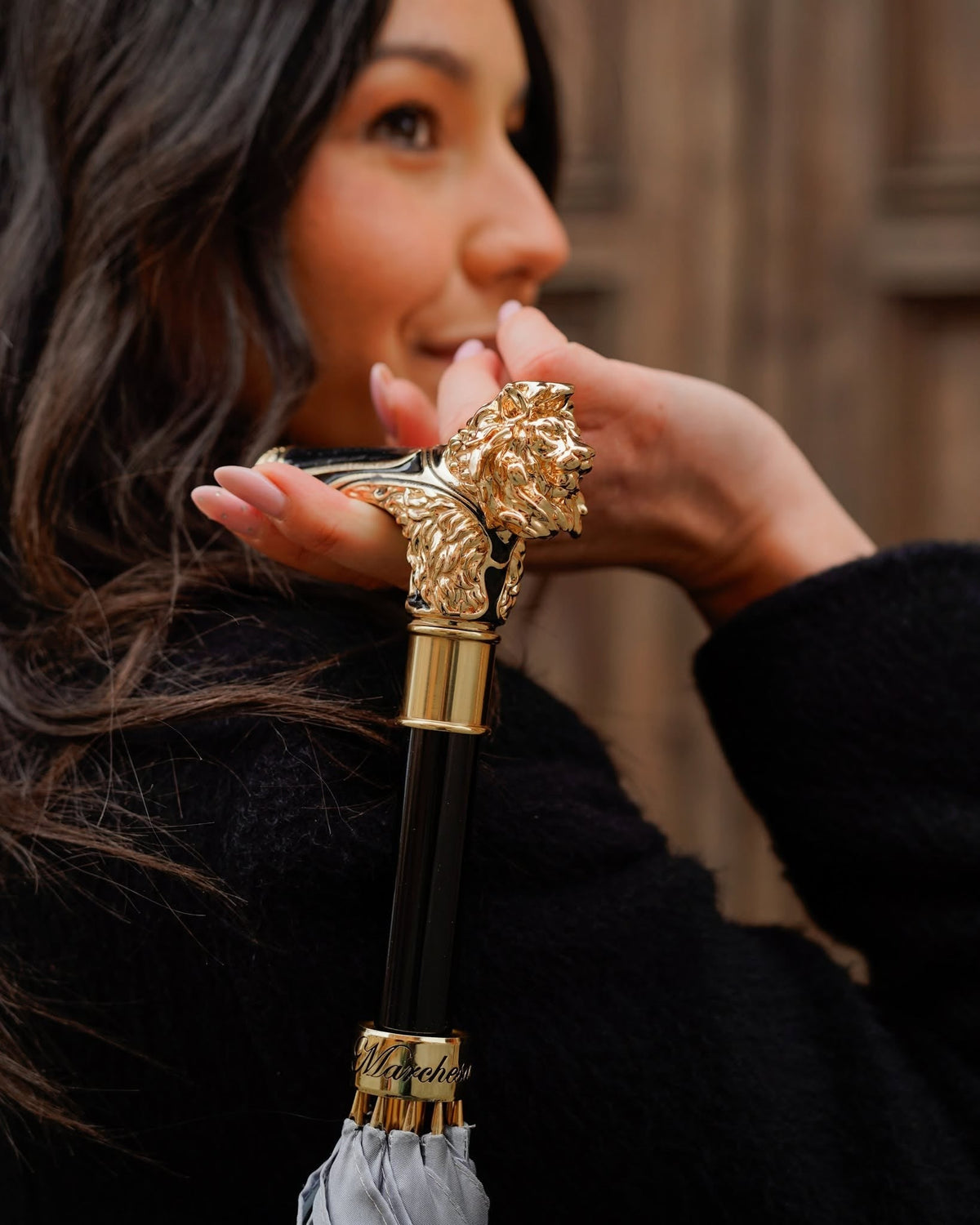
Most damaged umbrellas that reach our workbench were never caught in a storm. They were closed wet, stood in a metal stand, and forgotten in a hall closet for a season. Humidity, not rainfall, is what kills a hand-built umbrella. Cane cracks, silk spots, and ferrules seize because of how an umbrella waits between uses — not because of how it's used.
We package and ship handmade umbrellas from our workshop daily, in cane, briar, and horn handles sourced the same way they were a century ago. This is the storage and transport protocol we build every shipment around — the one we'd want a Pasotti or Il Marchesato owner to follow at home.
How to Store and Transport a High-End Umbrella Without Shortening Its Life?
The Core Rule: Dry Before Closed, Closed Before Stored
A wet canopy sealed inside a sleeve is a humidity chamber. Left overnight, moisture migrates into the shaft, the ribs' fabric loops, and — if the handle is natural cane, chestnut, or briar — into the wood itself. Wood swells, then cracks as it dries unevenly.
- Open the canopy fully after use, even indoors, for 30–60 minutes before closing it.
- Stand it tip-down, never handle-down — pooled water at the ferrule tip evaporates; pooled water at the handle stains leather grips and loosens horn joints.
- Never store in the sleeve while damp. The sleeve should go on only once the canopy is bone-dry.
The Storage Environment That Actually Matters
Every material in a hand-built umbrella — Malacca cane, briar burl, horn, silk pongee, brass — has a humidity and temperature band it tolerates. Outside that band, deterioration is a matter of when, not if.
Ideal ambient humidity: 45–55% relative humidity Danger threshold, low: below 30% RH — cane and wood handles desiccate and hairline-crack Danger threshold, high: above 65% RH — mold on canopy seams, corrosion at brass/steel joints Ideal temperature: 15–20°C (59–68°F), stable, away from direct heat sources Light exposure: out of direct sunlight — UV degrades silk dye and dries leather grips
This is not decorative advice. It's the same range we hold our workshop's finishing and storage room to before a Malacca-handled piece ever reaches a client — because cane that's been cut and cured still moves with ambient moisture for years after assembly.

Storage Behavior by Handle Material
| Handle Material | Primary Risk | Storage Note |
|---|---|---|
| Malacca / Whangee Cane | Cracking from rapid humidity swings | Keep away from radiators, car dashboards, AC vents |
| Briar / Chestnut Wood | Grain splitting, finish dulling | Wipe with dry cloth only; oil-condition every 6–12 months |
| Horn | Delamination at low humidity | Avoid below 35% RH — more moisture-sensitive than wood |
| Leather-Wrapped Grip | Stiffening, cracking | Store flat or hanging, never compressed in a tight sleeve |
| Silver / Brass Collar | Tarnish, oxidation at high humidity | Silica packet inside storage box; polish quarterly |
Transport: What Protects and What Damages
A hand-built umbrella traveling in a bag, suitcase, or car should never make contact with hard edges, other objects, or its own wet canopy. Three failure points account for most transport damage we see returned for repair:
- Rib stress — an umbrella wedged sideways in a bag flexes the ribs against their natural fold line, weakening the pivot points over repeated trips.
- Ferrule impact — the tip is the most fragile point on a cane-shafted umbrella; a hard knock can split the shaft internally without visible surface damage.
- Compression on the handle — packing other items against a horn or cane handle transfers pressure unevenly across a curved surface, which is where hairline cracks start.
Every umbrella shipped from Artisan Umbrellas travels in a rigid-core canvas sleeve with a breathable cotton lining — not the sealed plastic most retailers use. Plastic traps residual moisture against the canopy and accelerates exactly the humidity damage described above. The breathable sleeve is also what we recommend clients keep and reuse for day-to-day transport, since it manages moisture the same way the shipping packaging does.
Fact: Sealed synthetic sleeves trap residual canopy moisture against fabric and metal joints. Metric: Breathable canvas sleeves reduce trapped internal humidity versus sealed plastic in side-by-side workshop humidity tests. Insight: The sleeve material matters as much as the storage room — it's the microclimate the umbrella actually lives in.
Full configuration matrix Storage tolerances shift by canopy fabric, cane origin, and finish treatment — a waxed pongee canopy and a waterproof twill canopy do not behave the same way in a coastal climate versus a dry inland one. We maintain a full humidity/temperature matrix broken out by material combination and climate zone for every model we sell.

The Weekly and Seasonal Maintenance Cadence
- After every use: open fully, air-dry, wipe ferrule dry before closing.
- Weekly (in regular rotation): check rib joints for stiffness; a joint that resists opening smoothly needs a trace of dry lubricant, not force.
- Quarterly: polish metal collar and ferrule; inspect handle for surface hairlines under raking light.
- Seasonally (climate change): move storage location if the room's humidity shifts more than 15 points between seasons — attics and garages are the two worst offenders.
What to Avoid Entirely?
- Storing tip-up in a stand — water collects at the canopy's center and drains toward the handle.
- Drying with a hairdryer or near a heat vent — rapid drying is what cracks cane, not moisture itself.
- Hanging by a leather or horn handle for extended storage — sustained weight on the joint where handle meets shaft is a slow-motion failure point.
- Silicone or petroleum-based sprays on cane or wood — they seal the surface and trap moisture inside instead of letting it regulate.

Frequently Asked Questions
How long can a wet umbrella stay closed before it's damaged? Meaningful risk starts after roughly 8–12 hours closed and wet in normal room conditions — faster in a sealed bag or car trunk where humidity has nowhere to go.
Is a plastic umbrella sleeve bad for storage? For daily transport of a dry umbrella, no. For storing a damp one, yes — sealed plastic holds moisture against the canopy and metal joints instead of letting it dissipate, which is why breathable canvas is standard for cane-handled pieces.
Can I store a cane-handled umbrella in a car? Only briefly. Car interiors swing far outside the 15–20°C / 45–55% RH range, especially in direct sun, and that swing is precisely what cracks cane and delaminates horn.
Does an umbrella stand damage the handle? Standard stands are fine tip-down. Handle-down storage is the problem — it puts the most humidity-sensitive material at the point closest to any residual moisture in the shaft.
Partager:
The History of the Umbrella: From Ancient Sunshade to Modern Rain Gear
Parasol, Sunshade, or Luxury Umbrella? The Three Words the Industry Uses Wrong