

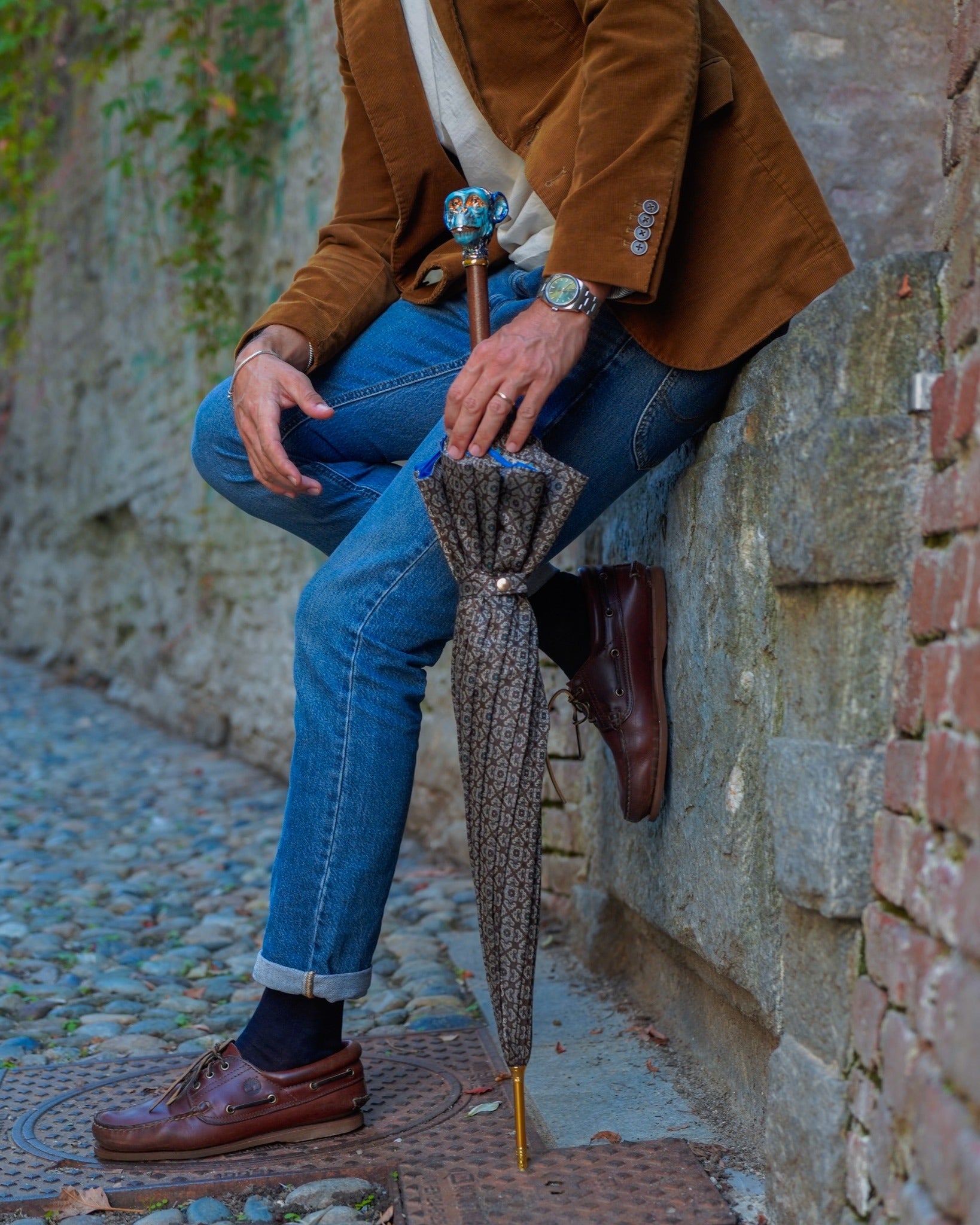
Pull up any luxury consignment marketplace and search "Burberry umbrella." You'll find dozens of listings — Nova Check, Horseferry nylon, patterned canopies — priced between $150 and $375, most marked down 20–30% from retail, many sitting unsold for months. Now search "artisan umbrella" or "bespoke umbrella." The results are almost empty. Not because nobody makes them. Because nobody sells them.
That single observation, made while auditing resale platforms for our own workshop's material sourcing, is the entire thesis of this article: branded umbrellas depreciate like fashion accessories. Bespoke umbrellas don't circulate — because owners don't let go of them.
Bespoke Umbrella vs. Designer Brand Umbrella: Which Is the Smarter Investment?
The Resale Test: What Actually Happens After Year One
We pulled live and recently-sold listings across major consignment platforms to compare designer-branded umbrellas against artisan-made pieces built with the same category of investment (chestnut or malacca shafts, hand-stitched canopies, forged steel mechanisms).
Fact: A Burberry Nova Check umbrella with an estimated retail of $260–$375 typically resells for $190–$300 within its first two resale cycles — a 20–35% markdown even in "excellent" condition, before further discounting.
Fact: Louis Vuitton monogram umbrellas list around $625 against retail pricing near $900–$1,000 — comparable depreciation, cushioned only by brand monogram recognition.
Metric: Across the designer umbrella category, resale value clusters at 60–75% of original retail, and that's for pieces in pristine, tagged condition. Worn handles, faded canopy print, or missing dust bags push this lower fast.
Insight: These aren't heirloom objects. They're branded consumables with a logo tax. The canopy fabric, the mechanism, the handle material — none of it is built to outlast a decade of real use, so the resale price reflects wear, not craftsmanship.
Bespoke and artisan-made umbrellas don't show this pattern — not because they hold value better on paper, but because the secondary market for them barely exists. Owners keep them, repair them, and pass them down. An umbrella built on a hand-carved malacca shaft with a full steel frame doesn't behave like a fashion accessory losing seasonal relevance. It behaves like a tool that improves with age, the way a well-kept blade or a bench-made shoe does.
The full comparative resale dataset — broken down by shaft material, canopy type, and mechanism grade across five-year ownership windows — is available on the [Artisan Umbrellas product specification pages → link placeholder].

Why Branded Umbrellas Lose Value Faster: The Construction Gap?
Designer umbrella houses license production. The name on the canopy rarely matches the workshop that built the frame. This creates three structural weaknesses that show up in resale condition reports:
| Factor | Designer Brand Umbrella | Artisan / Bespoke Umbrella |
|---|---|---|
| Frame material | Often aluminum or coated steel, mass-tooled | Forged carbon or full steel, hand-fitted |
| Canopy fabric | Printed nylon or polyester twill | Hand-cut pongee silk or waxed cotton, sewn not glued |
| Shaft | Hollow aluminum or lacquered wood veneer | Solid chestnut, malacca, or hickory, one-piece |
| Repairability | Not designed for part replacement | Built for re-canopying and mechanism service |
| Typical resale retention (2–5 yrs) | 60–75% of retail, declining with visible wear | Rarely resold; functional lifespan often exceeds 20 years |
| Primary value driver | Logo recognition | Material integrity and construction |
The frame is the tell. A licensed umbrella is engineered to a retail price point — the brand margin has to come from somewhere, and it comes out of the mechanism and the shaft. That's why a designer umbrella's ribs bend in wind gusts that a properly tensioned steel frame shrugs off, and why the canopy print fades while a dyed silk or waxed-cotton canopy on an Artisan Umbrellas piece holds its color for a decade of seasonal use.
The Real Cost-Per-Year Math
Run the numbers instead of the sticker price:
- Designer umbrella: $300 retail, realistic functional lifespan of 3–5 years before mechanism failure or canopy fading → $60–$100 per year, plus near-total value loss on resale.
- Bespoke / artisan umbrella: $350–$600 retail, functional lifespan of 15–25 years with occasional re-canopying → $14–$40 per year, and the object typically appreciates in sentimental and material value rather than depreciating.
Insight: Price-per-year, not price tag, is the correct investment metric — the same logic collectors already apply to mechanical watches and full-grain leather goods. On that basis, the "expensive" bespoke option is the cheaper asset over any meaningful ownership window.

What to Check Before You Buy Either?
If you're comparing a designer name against a bespoke commission, three specifications separate a genuine long-term asset from a branded consumable:
- Frame gauge and rib count — thin-gauge steel or fewer than 8 ribs means the canopy will invert in moderate wind within the first season.
- Shaft construction — one-piece solid wood or forged shaft, not a veneer over hollow aluminum.
- Canopy attachment method — stitched, not glued. Glued seams fail within 2–3 years of regular exposure.
Every umbrella in the Artisan Umbrellas collection is specified against exactly these three criteria before it reaches a customer, which is why our pieces are built to be re-canopied rather than replaced.
Exact frame gauge, rib count, and shaft specifications by model are listed on each product page at [Artisan Umbrellas → link placeholder].
The Verdict
Choose a designer brand umbrella if: brand recognition is the primary goal, the item will see occasional or seasonal use, and you're comfortable with it functioning as a 3–5 year fashion accessory rather than a durable object.
Choose a bespoke or artisan umbrella if: you want a piece that survives a decade or more of daily use, holds material and functional value rather than logo value, and can be repaired rather than replaced.
True luxury, in this category as in watches or knives, was never the logo. It's the material specification and construction that let an object outlive its trend cycle — and that's the variable resale data actually confirms.
Share:
The 7 Non-Negotiable Quality Markers When Buying a Premium Umbrella
What to Look for When Buying a Luxury Umbrella as a Corporate Gift?