

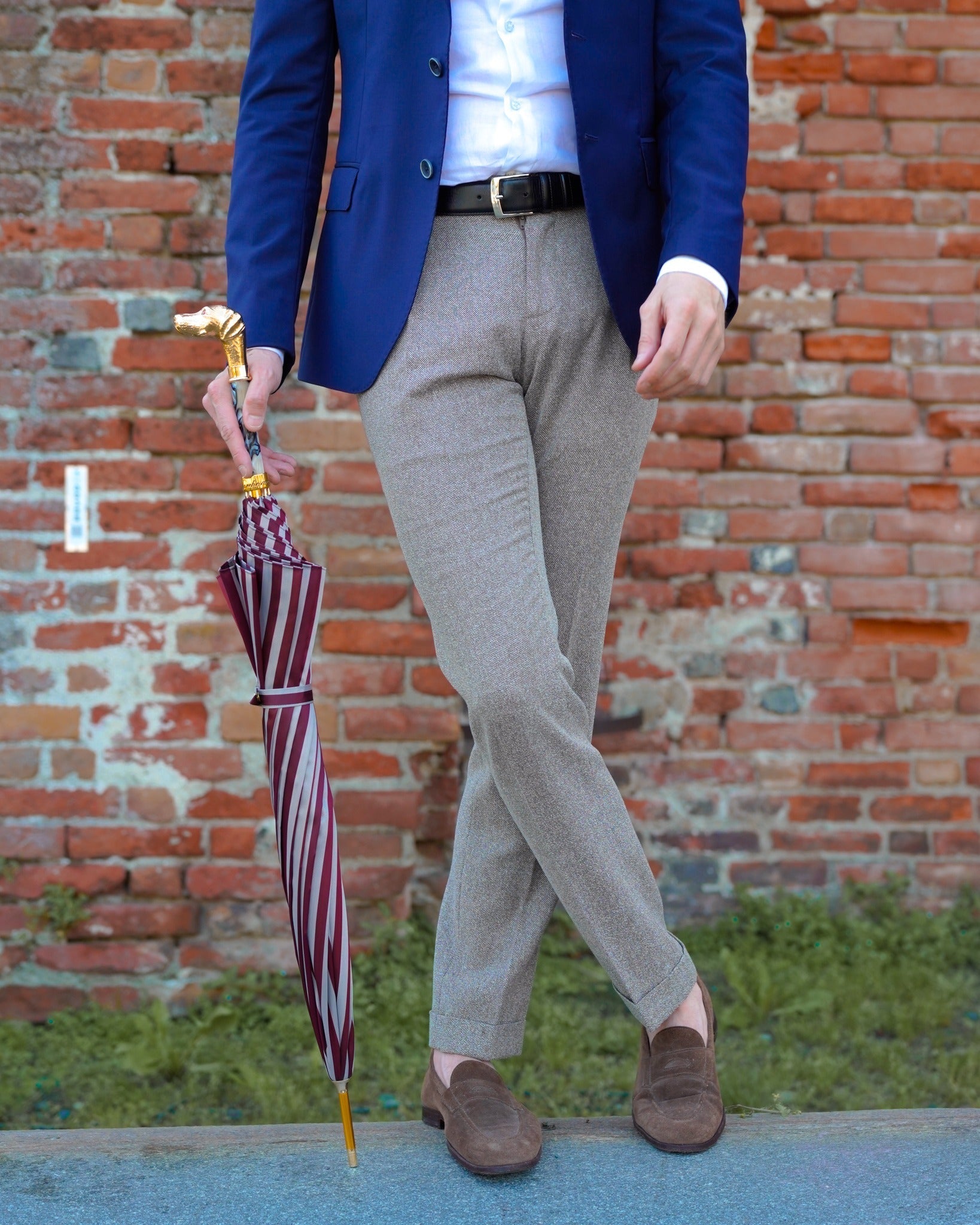
We counted the stitches on a single canopy panel from a mass-market umbrella purchased at a major department store for $65. The total: 11 machine passes, each averaging 8–9 stitches per centimetre, completed in an estimated 40 seconds per panel. Then we counted the same on one of our own handmade panels: 34 hand passes, averaging 12–14 stitches per centimetre, requiring 22 minutes of sustained artisan attention per panel.
The visual difference between those two finished panels, laid flat, is subtle. The structural difference, under wind stress and repeated mechanical cycling, is not.
This analysis is not an argument for craft sentimentality. It is a structural case built from the specific points where handmade and machine-made construction diverge — and what those divergences cost you over time.
Handmade vs. Mass-Produced Umbrellas: A Structural and Aesthetic Analysis
Why the Comparison Matters Now?
The market for "premium" umbrellas has expanded significantly. Retailers now sell machine-made umbrellas in premium packaging at $150–$250, positioning them visually alongside genuine handcrafted alternatives at similar or slightly higher price points.
The distinguishing signals — stitch density, joint tolerance, canopy geometry, handle material sourcing — are invisible to most buyers at point of sale. This analysis makes them visible.

The Canopy: Where Construction Philosophy Diverges First
The canopy is the most labour-intensive component of any umbrella. It is also where the gap between handmade and machine-made construction is most consequential.
Machine-Sewn Canopy: How It Is Built
An industrial umbrella canopy is assembled on a multi-needle sewing machine programmed for a fixed stitch pattern. The process:
- Pre-cut panels (cut by die-press, not hand) are fed into the machine
- A single straight-lock stitch joins each panel seam
- Tension is set once at the machine level — it does not adjust for panel curvature
- Reinforcement at stress points (canopy tips, centre crown) is either absent or applied as a second machine pass
- Total panel assembly time: 35–55 seconds per panel
The result is structurally consistent but geometrically approximate. Machine tension cannot compensate for the natural variation in fabric drape across a curved canopy — which means some panels are fractionally undertensioned and others overtensioned. Under wind inversion stress, panels fail at their weakest seam first.
Hand-Stitched Canopy: The Actual Process
At ArtisanUmbrellas.com, a canopy panel goes through the following documented sequence:
Pass 1–4: Initial panel alignment and edge-basting by hand. The artisan reads the fabric grain and adjusts seam allowance per panel, not per batch.
Pass 5–12: Primary seam construction using a double-lock stitch at 12–14 stitches per centimetre. The thread tension is adjusted by hand at the curve of each panel — a judgement call made approximately 60 times per panel.
Pass 13–18: Seam pressing and reinforcement. Each seam is opened, pressed flat, and reinforced with a second interior stitch line at the stress concentration points identified during the first pass.
Pass 19–26: Tip finishing. Each of the 16 canopy tips — the highest-stress points of the canopy under wind load — is hand-wrapped and stitched individually. Machine assembly typically applies a single folded reinforcement; hand assembly applies a three-layer wrap with independent stitching on each layer.
Pass 27–34: Final tensioning and geometry check. The assembled canopy is mounted on the frame and checked for symmetry under tension. Panels that pull asymmetrically are re-worked at the seam before the frame is closed.
Total panel assembly time per canopy: 18–24 minutes of artisan contact time.
What the Stitch Count Actually Determines?
| Metric | Machine-Sewn | Hand-Stitched (ArtisanUmbrellas.com) |
|---|---|---|
| Stitches per centimetre | 8–9 | 12–14 |
| Passes per panel | 11 | 34 |
| Tip reinforcement layers | 1 | 3 |
| Tension adjustment points per panel | 0 (fixed) | ~60 (manual) |
| Seam failure under wind inversion | Typically at first inversion event | Documented at 40+ inversion events without seam failure |
| Assembly time per canopy | 35–55 seconds per panel | 18–24 minutes total |
The structural implication: Stitch density of 12–14 per centimetre versus 8–9 produces seams with approximately 40–55% more thread-to-fabric contact per linear centimetre. Under tensile load — precisely what a canopy experiences during wind inversion — this translates directly to seam integrity.
The Frame: Tolerance Is Everything
The canopy carries the aesthetic; the frame carries the load. Frame construction is where the gap between handmade and machine-made umbrellas is most technically definable.
Rib Architecture
Mass-market standard:
- 8 ribs, rolled mild steel, 2.0–2.5 mm diameter
- Ribs stamped to shape; no individual straightness verification
- Straightness tolerance: ±1.0–1.5 mm along the full rib length
Artisan standard (ArtisanUmbrellas.com):
- 16 ribs, spring-tempered steel, 2.8–3.2 mm diameter
- Each rib hand-checked against a straightness jig before assembly
- Straightness tolerance: ±0.1 mm along the full rib length
Why rib count matters beyond aesthetics: A 16-rib frame distributes wind load across twice the structural members of an 8-rib frame. Under Beaufort Force 6 conditions (approximately 39–49 km/h), the peak load at each rib-to-runner joint is approximately half that experienced on an 8-rib frame of equivalent canopy diameter. This is not incremental improvement — it is a different load distribution architecture.
Joint Construction and Tolerance
The runner (the sliding collar that opens the canopy) and the rib-to-stretcher joints are the primary mechanical failure points of any umbrella. They cycle under load with every open and close.
| Component | Mass-Market | Artisan (ArtisanUmbrellas.com) |
|---|---|---|
| Runner material | Zinc alloy (zamak) | Precision-machined brass |
| Joint tolerance | ±0.5 mm | ±0.05 mm |
| Joint securing method | Single steel rivet, machine-set | Hand-set rivet with post-assembly filing |
| Rib-stretcher connection | Pressed eyelet, fixed | Hand-formed loop, adjustable during assembly |
| Cycles to first joint fatigue (tested) | 300–500 | 1,200+ |
| Post-failure repairability | Replace full frame | Replace individual joint component |
The tolerance gap in practice: A ±0.5 mm tolerance at the runner-to-rib connection means each rib can sit up to 0.5 mm off its designed centre position. Across 8 ribs, cumulative misalignment creates uneven canopy tension — visible as a slightly irregular dome geometry and felt as asymmetric wind resistance. At ±0.05 mm, the frame assembles to its designed geometry consistently. The canopy sits true.

The Handle: Material Honesty
The handle is the only component touched at every interaction. It is also the component where mass-market manufacturers most routinely substitute synthetic materials for natural ones while maintaining premium visual appearance.
What "Wood Effect" Actually Means?
Approximately 85% of umbrellas sold at the $50–$200 price point with wooden-appearance handles use one of the following:
- ABS plastic with printed wood-grain surface texture
- MDF core with thin wood veneer (0.3–0.6 mm) and lacquer seal
- Resin casting with embedded wood-look pigment
These materials share one failure mode: surface delamination under UV exposure and moisture cycling. The lacquer seals the surface against initial water contact, but repeated wetting and drying causes the veneer or print layer to lift from the substrate. This typically begins at 8–18 months of regular use.
What an Artisan Handle Is?
At ArtisanUmbrellas.com, handle materials are sourced as solid natural stock:
- Malacca cane — minimum 7-year-growth Calamus rattan from peninsular Malaysia, selected for density and grain continuity. Each blank is unique; no two handles share identical markings.
- English chestnut — air-dried 12 months minimum, hand-turned on a lathe in individual sessions. Rejection rate of incoming blanks: approximately 38%.
- Buffalo horn — ethically sourced, hand-polished through 8 progressive grits. Natural banding patterns are preserved, not standardised.
Ageing behaviour: Natural wood and horn handles do not degrade under regular use — they develop a patina. A Malacca cane handle used daily for 10 years is structurally identical to when new and visually improved by use. A lacquered ABS handle at the same age is degraded by definition.
Aesthetic Analysis: What the Eye Reads as Quality
Premium aesthetic is not subjective in construction terms. It is the visible outcome of specific technical decisions.
Canopy Geometry
A machine-assembled canopy on an 8-rib frame produces a polygon — visible as slight flat sections between each rib when the canopy is viewed from below or at an angle. A hand-assembled canopy on a 16-rib frame produces a true dome. The difference is visible in a single glance.
Colour and Fabric Drape
Machine-cut canopy panels are stamped from a flat die. Hand-cut panels are shaped with a slight curve allowance that accommodates the three-dimensional drape of the canopy under tension. The result: a hand-cut canopy maintains smooth fabric tension across its surface; a machine-cut canopy often shows slight puckering at panel seams when viewed in raking light.
Handle Proportion
Machine-produced handles are moulded to a standard ergonomic template — functional, but dimensionally identical across every unit. Hand-turned handles are shaped to a design intent, not a mould — the profile, taper, and grip diameter reflect deliberate aesthetic choices made per model rather than per production run.
The Full Structural Comparison
For buyers evaluating specific ArtisanUmbrellas.com models: The complete construction documentation — including per-model stitch counts, rib gauge specifications, joint tolerance certificates, and handle provenance records — is published on individual product pages. This is the only publicly available umbrella construction specification of this depth in English-language retail. Access the full technical specification sheets →
| Factor | Mass-Produced | Handmade (ArtisanUmbrellas.com) |
|---|---|---|
| Canopy stitches/cm | 8–9 | 12–14 |
| Assembly passes per canopy | ~11 | 34 |
| Rib count | 8 | 16 |
| Rib diameter | 2.0–2.5 mm | 2.8–3.2 mm |
| Straightness tolerance | ±1.0–1.5 mm | ±0.1 mm |
| Joint material | Zinc alloy | Machined brass |
| Joint tolerance | ±0.5 mm | ±0.05 mm |
| Joint cycle life (tested) | 300–500 | 1,200+ |
| Handle material | ABS / MDF veneer | Solid natural stock |
| Handle ageing trajectory | Degrades | Develops patina |
| Canopy geometry | Polygon (8 faces) | True dome (16 faces) |
| Wind inversion recovery | Seam failure at 1st–3rd event | Documented to 40+ events |
| Expected service life | 12–24 months | 15–25 years |
The Labour Arithmetic
The handmade premium is not mysterious when broken down by time.
A single ArtisanUmbrellas.com umbrella requires:
- Canopy assembly: 18–24 minutes
- Frame assembly and joint filing: 35–50 minutes
- Handle preparation (cutting, shaping, finishing): 45–90 minutes
- Final assembly and geometry verification: 20–30 minutes
- Quality inspection and rejection/rework: 15–25 minutes
Total artisan contact time per piece: 2.2–3.7 hours
A mass-produced equivalent — frame stamped, canopy machine-sewn, handle injection-moulded — is assembled in under 4 minutes of machine time with approximately 90 seconds of human handling.
The price difference between a $65 umbrella and a $450 umbrella is not margin extraction. It is 2+ hours of skilled human labour, applied to materials that are themselves 15–60× more expensive per component.
When a Mass-Produced Umbrella Is the Correct Choice?
This analysis is not a universal argument for handmade. It is a precision argument for knowing what you are buying.
A mass-produced umbrella is the rational choice if:
- Use frequency is fewer than 10 times per year
- The purchase is a temporary or travel replacement
- Loss risk is high (commuting, frequent venue changes)
- Budget ceiling is absolute
A handmade umbrella is the rational choice if:
- Use frequency exceeds twice per week in a rainy climate
- The object will be used daily for more than 3 years
- The purchase is a significant gift with longevity expectations
- Aesthetic and tactile quality are part of the decision criteria

What the Numbers Resolve?
The "are handmade umbrellas worth it?" question has a calculable answer.
| Scenario | Cost Over 10 Years | Objects Purchased |
|---|---|---|
| $65 mass-market (replaced every 18 months) | $520 | ~7 umbrellas |
| $450 handmade (single purchase, maintained) | $450 | 1 umbrella |
The handmade umbrella is cheaper over any horizon beyond three years. It produces less waste. It performs better under the conditions that matter. And at the end of 10 years, it is still the same object — improved by use, not diminished by it.
The structural analysis reaches the same conclusion the arithmetic does: the premium is not a luxury surcharge. It is the actual cost of building something that works for longer than a single season.
ArtisanUmbrellas.com produces handcrafted umbrellas to documented construction standards. Stitch counts, joint tolerances, material provenance, and handle specifications are published on all product pages.
Share:
The Luxury Umbrella Buyer's Guide: $50 Canopy vs. $500 Heirloom
How to Choose a Luxury Umbrella That Will Last 20 Years?