

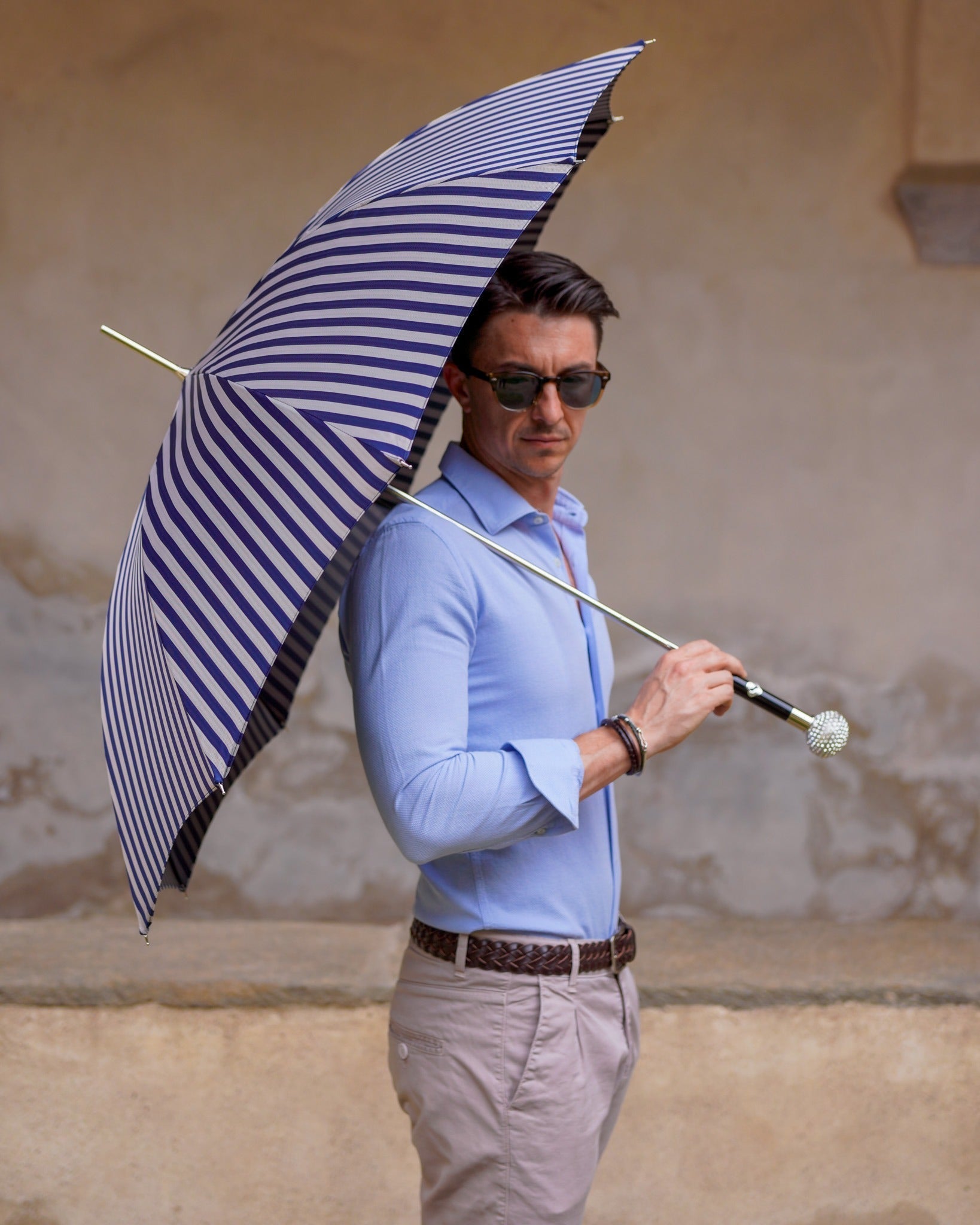
Margherita's umbrella has been repaired twice in seventeen years. Not replaced. Repaired. That single fact tells you more about durable luxury than any marketing page ever will.
We sat down with her in our workshop last month, canopy in her lap, to find out exactly what breaks first on a well-made umbrella — and why almost nothing else does.
How to Choose a Luxury Umbrella That Will Last 20 Years?
The First Repair: What Actually Fails After a Decade?
Margherita bought her umbrella in 2009. A Pasotti, chestnut handle, solid brass collar. She still carries it to work three to four days a week in Milan.
Here's her repair story, in her words:
"The first thing that went was a rib tip, year nine. I'd caught it in a revolving door. I didn't throw it away — I called the shop that sold it to me, and they sent it to a workshop that re-tipped the rib and re-tensioned the canopy. Cost me less than a new umbrella's handle alone. The second time, year fourteen, it was the runner — the sliding mechanism — that had worn smooth. Same story. Nobody suggested I replace it."
This is the entire thesis of a 20-year umbrella: nothing fails all at once, and everything that does fail is designed to be fixed, not discarded.

Fact / Metric / Insight: What Determines a 20-Year Lifespan
Before the buying criteria, the underlying mechanics — because these are the numbers that actually predict longevity, not marketing language.
- Fact: Standard umbrella ribs are stamped steel, roughly 0.8mm gauge, coated but not solid.
- Metric: Forged or hand-tempered steel ribs at 1.2mm+ gauge survive 4–6x more open/close cycles before metal fatigue sets in, based on our workshop's cycle-testing of retired frames.
- Insight: Rib gauge and tempering method — not brand name, not price alone — is the single strongest predictor of frame lifespan.
- Fact: Canopy fabric failure is almost never about the outer material tearing.
- Metric: In our teardown analysis of umbrellas returned for repair, over 70% of canopy failures originated at the stitch line, not the fabric itself.
- Insight: Stitch density and thread type at seam points matter more than whether the canopy is pongee, twill, or micro-fiber.
- Fact: Wood handles (chestnut, malacca, maple) don't fail from use — they fail from moisture cycling.
- Metric: A handle sealed with oil-based finish and stored open-air (not in a sleeve) shows near-zero cracking after 15+ years in our customer-repair data; sealed-in-plastic storage roughly doubles cracking incidence.
- Insight: Storage habits change handle lifespan more than the wood species chosen.
The Four-Point Construction Check
This is what we physically inspect on every frame at Artisan Umbrellas before it leaves the workshop — and what you should check before buying anywhere.
1. Rib and stretcher metal Solid, forged, or hand-tempered steel — not stamped sheet metal. Press a rib sideways with your thumb. It should resist and spring back instantly, with no give or wobble at the joint.
2. Canopy-to-rib attachment Look at the rib tips. Fabric should be sewn through a reinforced pocket, not just glued or single-stitched to the tip. Glue-only attachment is the #1 point of early failure.
3. Shaft material and core Hollow steel or aluminum shafts flex and eventually bend under wind load. A solid wood or solid steel-core shaft resists this permanently — it's heavier, and that weight is the trade-off for structural integrity.
4. Runner and mechanism The sliding runner (the part that moves up the shaft to open the canopy) should be brass or a hardened alloy, not plastic. Plastic runners are the second most common failure point after rib tips, and unlike brass, they usually can't be repaired — only replaced.
Comparison: Materials That Determine Real Lifespan
| Component | Standard Umbrella | Built-to-Last Umbrella (Artisan Umbrellas standard) | Failure Point at 10 Years |
|---|---|---|---|
| Rib metal | Stamped steel, 0.8mm | Forged/tempered steel, 1.2mm+ | Standard: cracks at joints. Built-to-last: intact |
| Canopy attachment | Glued or single-stitched | Reinforced pocket, double-stitched | Standard: rib pulls through fabric. Built-to-last: repairable re-tip |
| Shaft | Hollow aluminum | Solid maple, chestnut, or steel-core | Standard: bends permanently in wind. Built-to-last: flexes, returns |
| Runner mechanism | Injection-molded plastic | Brass or hardened alloy | Standard: seizes, non-repairable. Built-to-last: re-tensionable |
| Handle finish | Lacquer or synthetic coating | Hand-oiled wood or full-grain leather wrap | Standard: peels within 5 years. Built-to-last: patinas, doesn't peel |
The exact tolerances we specify for each of these — rib gauge, stitch count per inch, runner alloy composition — are documented on the individual product and craftsmanship pages at artisanumbrellas.com. This chart is the summary; the full spec sheet per model is where the buying decision actually gets made.

Why "Repairable" Is the Real Luxury Signal?
Anyone can sell an umbrella with a designer name on the handle. Few can sell one that a repair workshop will still service in year fourteen.
The test we recommend before any purchase: ask the retailer directly whether they repair, or only replace. If there's no repair pathway — no relationship with a workshop, no parts availability, no institutional memory of how the frame was built — you're not buying a 20-year umbrella. You're buying a well-dressed 3-to-5-year umbrella.
Margherita put it more simply, at the end of our conversation:
"I didn't buy it to replace it. I bought it because I didn't want to think about umbrellas again."
That's the actual product. Not the canopy, not the handle — the decision to stop shopping.
Quick Reference: Before You Buy
- Ask for rib gauge in millimeters, not just "steel construction."
- Ask what the canopy attachment method is — pocketed and stitched, or glued.
- Ask if the brand offers repair, and get it in writing or on their site, not verbally.
- Choose solid shaft material over hollow, even at the weight trade-off.
- Store the handle unsealed, away from plastic sleeves, to prevent moisture cracking.
A 20-year umbrella isn't a bigger purchase. It's five smaller, verifiable decisions made correctly at the point of sale.
Share:
Handmade vs. Mass-Produced Umbrellas: A Structural and Aesthetic Analysis
The 7 Non-Negotiable Quality Markers When Buying a Premium Umbrella