

I didn’t notice the difference at first.
It was raining, nothing unusual, and I had an umbrella in my hand that—on the surface—did everything it was supposed to do. It opened, it covered me, it kept the water away. I walked without thinking about it.
Then one day, I picked up a different one.
And something shifted.
Not dramatically. No obvious feature stood out. But the way it opened, the way it settled above me, even the way it felt in my hand—it all felt more… resolved. Like small decisions had been made carefully, even in places I hadn’t thought to look.

That’s when I started noticing the hidden details.
The first thing I became aware of was the mechanism.
Most umbrellas open with a quick motion, almost abrupt. But some unfold with a kind of controlled pace. There’s resistance, but not friction. The structure expands evenly, without that slight imbalance you sometimes feel when one side opens faster than the other.
It’s subtle.
But it changes how the object feels from the very first interaction.
Then there’s the frame.
I used to think of it as something purely functional—just the part that holds everything together. But over time, I noticed how different frames respond to movement.
In wind, especially.
Some umbrellas react nervously, shifting unpredictably, almost fighting the air. Others absorb it. They flex slightly, adjust, then return to their shape without making it feel like something is about to give way.

That kind of stability doesn’t draw attention to itself.
But you feel it.
The canopy is another detail that reveals more the longer you use it.
At a glance, most fabrics look similar. But under rain, differences appear. Water either beads and rolls off quickly, or lingers, soaking in slightly before dripping away.
And that changes everything.
A canopy that sheds water efficiently doesn’t just keep you dry—it keeps the umbrella lighter, more manageable. It prevents that gradual heaviness that builds without you noticing.
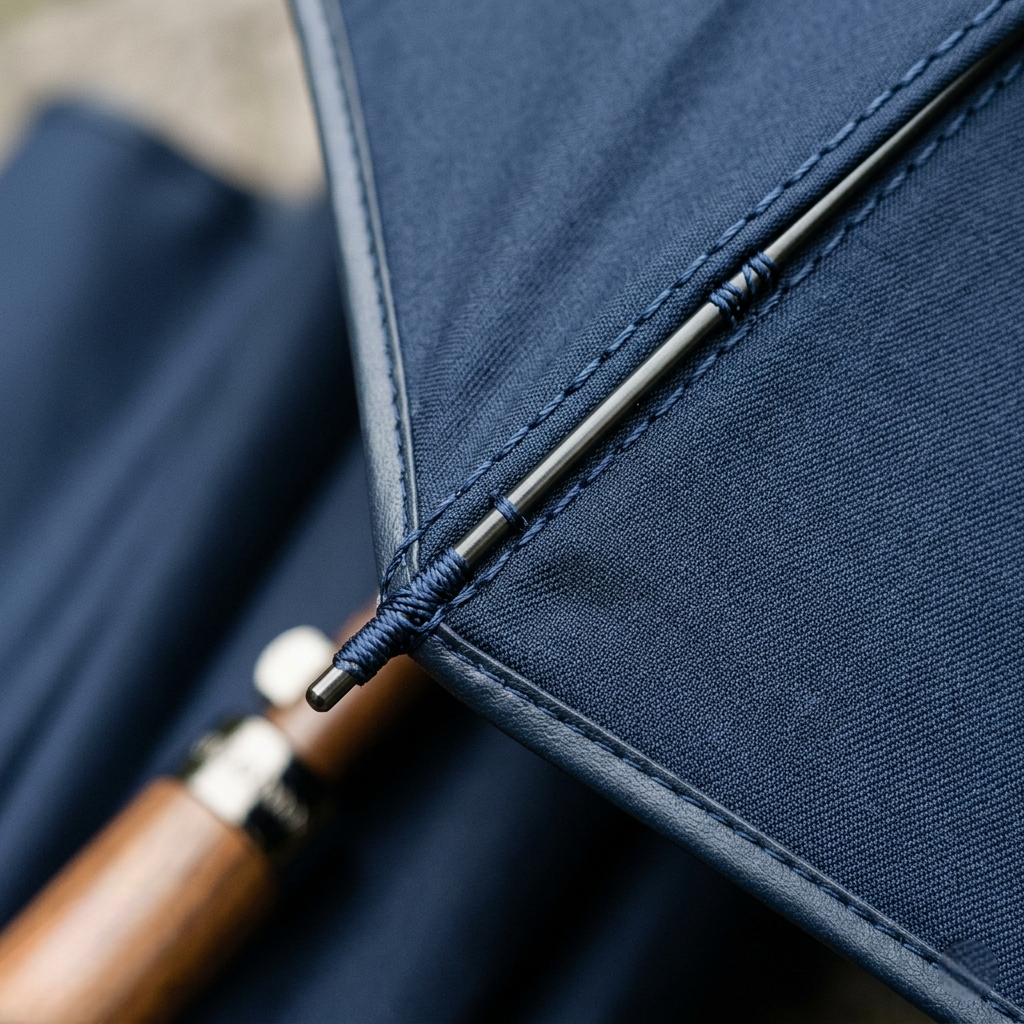
Stitching was something I overlooked completely at first.
Until I saw it up close.
The way panels are joined, the precision of each line, the consistency—it all contributes to how the canopy holds its shape. Uneven stitching creates small tensions, subtle distortions that you might not see immediately, but feel over time.
Clean stitching keeps everything aligned.
It allows the form to remain stable, even after repeated use.
The handle is where things become more personal.
It’s the one part you’re constantly in contact with, yet it’s often reduced to appearance. But the way it feels in your hand matters more than how it looks.
Some handles are too smooth, almost slipping slightly when wet. Others have a quiet texture that keeps them steady without being noticeable. The balance of the umbrella often reveals itself here too—how the weight is distributed, how naturally it rests when you hold it.
That balance affects how you carry it.
And how long you’re comfortable doing so.
I also began to notice the sound.
It’s something I never expected to matter. But there’s a difference between an umbrella that rattles slightly with each movement and one that remains almost silent.
That quietness suggests precision.
It means the parts fit together without unnecessary space, without looseness. It’s not about eliminating sound completely—it’s about removing what doesn’t need to be there.

And that absence creates a different experience.
Even the closing of the umbrella tells you something.
Some collapse quickly, almost carelessly, requiring you to readjust the fabric afterward. Others fold into themselves more naturally, the canopy aligning with the frame without resistance.
It’s a small detail.
But it’s one of the last interactions you have with the object each time you use it.
And it leaves an impression.
Over time, I realized that luxury in umbrellas isn’t about what you see immediately.
It’s about what remains consistent.
The way it opens the same way every time. The way it handles weather without changing its behavior. The way it feels familiar, not just functional.
Consistency is what builds trust.
And trust is what turns an object into something you rely on without thinking.
Of course, not every detail is perfect.
I’ve used umbrellas that felt refined in most ways but had small flaws—slightly stiff mechanisms, handles that didn’t quite match the rest of the design, fabrics that aged faster than expected.

These imperfections don’t ruin the experience.
But they remind you that true refinement is rare.
Because it requires attention to everything, not just the visible parts.
What changed for me is how I define quality now.
It’s no longer about how something looks at first glance.
It’s about how it behaves over time.
How it responds to use, to weather, to repetition. Whether it remains consistent, or slowly reveals weaknesses.
Luxury, in this sense, isn’t loud.
It’s quiet.
And it lives in details most people don’t notice—until they do.
So if you’re thinking about what defines a luxury umbrella, I wouldn’t start with design alone.
I’d pay attention to the small interactions.
How it opens. How it moves. How it feels in your hand. How it responds to rain and wind. How it closes.
Because those are the moments where quality becomes real.
Not visible.
But felt.



Share:
Best Umbrella for Your Style
Online vs In-Store Luxury Umbrella Buying Guide