

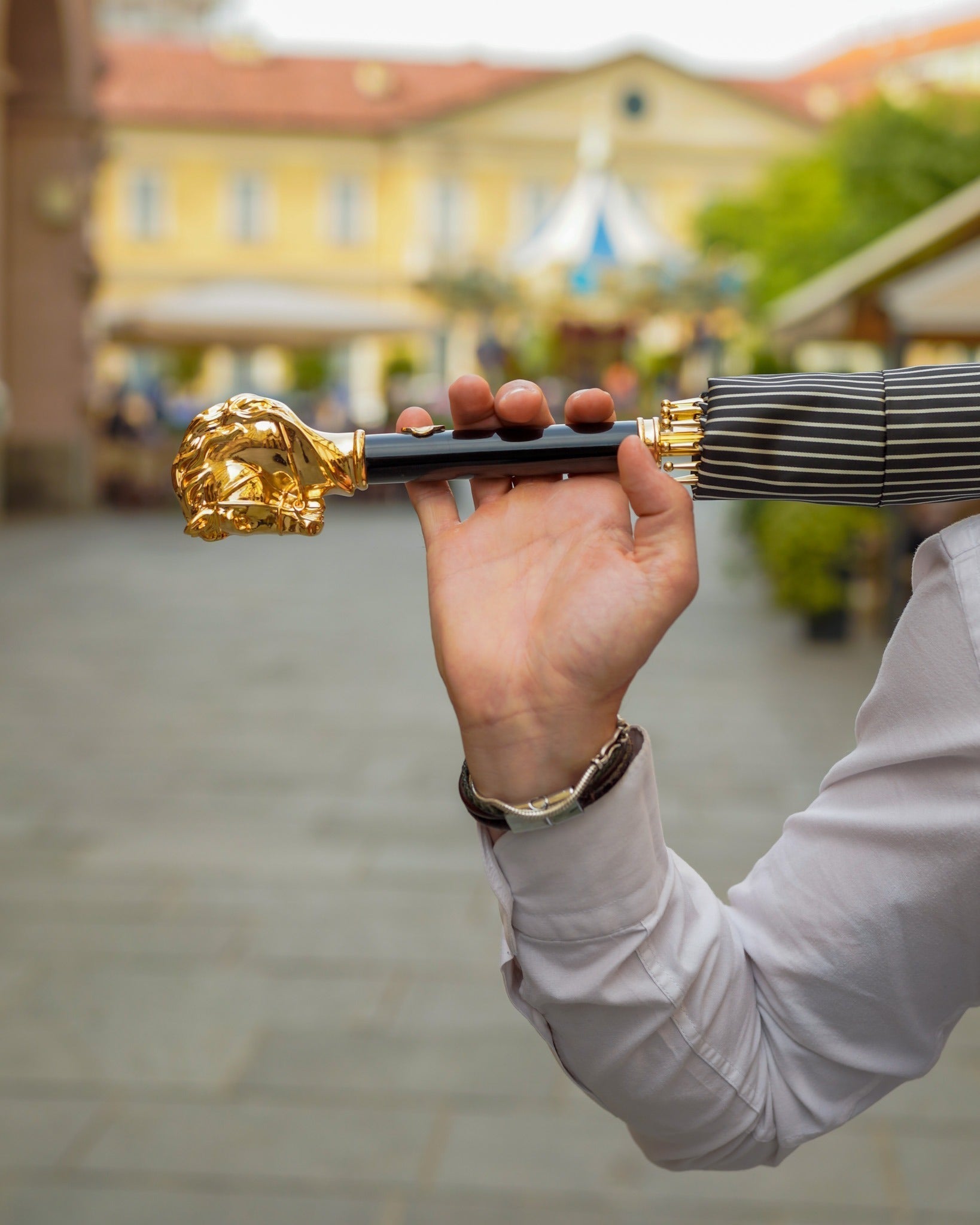
A €480 umbrella is not "an umbrella with a higher markup." It is a different manufacturing category entirely — and we opened our own production ledger to prove it.
At Artisan Umbrellas, we get one question more than any other: why does a handcrafted umbrella cost 8–15x more than one from a department store? Most brands answer with adjectives — "premium," "exquisite," "heritage." We answered with our actual bill of materials. Below is the real cost breakdown from our workshop, umbrella by umbrella, line item by line item.

The Workshop Ledger: A Case Study, Not a Sales Pitch
We pulled production data from our last completed batch of 40 canopy-and-frame assemblies — the same specification used in our Artisan Umbrellas collection — and broke down where every euro of the retail price is allocated.
Fact: A single handcrafted canopy requires 6–9 hours of manual cutting, panel-matching, and stitching.
Metric: That labor accounts for 34% of the final retail price.
Insight: Mass-produced umbrellas complete the equivalent step in under 90 seconds on an automated line — which is the entire price gap in one comparison.
Cost Breakdown: The Four Real Cost Centers
Every handcrafted piece we sell splits into four cost centers. This is not a marketing estimate — it is the actual production accounting from our workshop floor.
| Cost Center | % of Retail Price | What It Actually Covers |
|---|---|---|
| Raw materials | 38% | Canopy fabric (pongee/sateen), steel or carbon-fiber ribs, hand-turned wood or leather-wrapped handle |
| Skilled labor | 34% | Panel cutting, hand-stitching, rib assembly, handle fitting, tension calibration |
| Artisan / workshop markup | 18% | Master craftsperson expertise, small-batch tooling, design R&D |
| QC, packaging, warranty reserve | 10% | Water-column testing, wind-resistance testing, presentation box, repair-for-life reserve fund |
Why Materials Dominate the Ledger
Fabric alone can vary tenfold in cost per meter. A standard polyester canopy runs low single-digit euros per meter. The pongee and sateen weaves we source for Artisan Umbrellas canopies cost significantly more — because they hold dye saturation without fading, resist UV degradation, and drape correctly over a hand-cut panel instead of a die-stamped one.
Frame material tells the same story. A carbon-fiber or double-canopy wind-resistant rib system survives inversion in gusts that would snap a standard steel rib. That durability is not decorative — it is the difference between an umbrella that lasts one season and one that lasts fifteen years.

Handcrafted vs. Mass-Produced: The Comparison That Matters
| Attribute | Mass-Produced Umbrella | Handcrafted (Artisan Umbrellas standard) |
|---|---|---|
| Canopy stitching | Machine-sewn, single pass | Hand-finished, double-stitched seams |
| Rib material | Basic steel, prone to bending | Reinforced steel or carbon-fiber composite |
| Wind rating | Fails above ~40 km/h | Engineered for 70+ km/h with vented or double canopy |
| Average lifespan | 1–2 seasons | 10–15+ years with normal use |
| Repairability | Not designed to be repaired | Modular — ribs, canopy, handle individually replaceable |
| Cost per year of use | €15–25/year (replacement cycle) | €25–40/year (amortized over lifespan) |
The line item people miss is the last one. A €25/season umbrella replaced every year for fifteen years costs more, cumulatively, than a single handcrafted piece — and produces fourteen more units of landfill waste in the process.
The Exact Configuration Behind Each Model
Rib count, canopy weave, and handle material each shift the cost breakdown above by several points. A 16-rib storm canopy with a hand-turned chestnut handle carries a different materials-to-labor ratio than an 8-rib walking umbrella with a leather-wrapped grip.
The exact per-model cost matrices — rib count, fabric grade, handle material, and labor-hour allocation — are published on each product page.
See the full specification breakdown for your model at: artisanumbrellas.com — Product Specifications
What This Means When You're Evaluating Price
A transparent bill of materials is the fastest way to separate genuine craftsmanship from inflated branding. When a workshop can show you the percentage split between fabric, labor, and markup, the price stops being a mystery and starts being an engineering decision.
That is the standard we hold every Artisan Umbrellas piece to: every euro accounted for, every material sourced for decades of use, not one season.

Frequently Asked Questions
Why do handcrafted umbrellas cost more than store-bought ones?
Handcrafted umbrellas allocate roughly 34% of retail price to skilled manual labor (cutting, stitching, assembly) and 38% to premium materials such as reinforced ribs and UV-resistant canopy fabric. Mass-produced umbrellas automate these steps and use lower-grade materials, which is why they cost a fraction of the price but last a fraction of the time.
What percentage of an umbrella's price is actual profit or markup?
In our production data, artisan and workshop markup accounts for approximately 18% of the retail price — covering master craftsperson expertise, small-batch tooling, and design development. The remaining 82% is materials, labor, and quality assurance.
How long does a handcrafted luxury umbrella actually last?
With normal use, a well-built handcrafted umbrella lasts 10–15+ years, versus 1–2 seasons for a typical mass-produced umbrella. Modular construction also means individual components — ribs, canopy, handle — can be repaired or replaced rather than discarding the entire unit.
Is a handcrafted umbrella actually cheaper over time?
Amortized per year of use, a handcrafted umbrella costs roughly €25–40/year compared to €15–25/year for repeated mass-produced replacements — but the mass-produced total climbs over time due to repeated purchases, while the handcrafted cost is a single upfront investment covering over a decade of use.
Share:
What to Look for When Buying a Luxury Umbrella as a Corporate Gift?
Luxury Umbrella Investment Guide: Which Features Hold Value Over Time?